

Scottish salmon
Scottish salmon is not a separate species. It is Atlantic salmon, Salmo salar, farmed in Scotland. The term refers to origin rather than biology: the same species is also farmed in Norway, Ireland, the Faroe Islands and Chile.
Practically all Scottish salmon on the market comes from marine farming along the Scottish west coast and around the island groups. Wild Atlantic salmon from Scottish rivers plays almost no commercial role; river fishing is heavily regulated and largely catch and release. This page explains what the term Scottish salmon means, where farming takes place, which characteristics can and cannot be attributed to origin, and how Scottish and Norwegian salmon compare.
What is Scottish salmon?
Scottish salmon is Atlantic salmon (Salmo salar) raised in Scotland. It is a trade description based on origin, comparable to Norwegian salmon or Irish salmon. The species itself is the same in every case; the characteristics of the species are described on the page about Salmo salar.
Production runs in two phases. The fish starts its life in freshwater facilities, where it adapts to salt water as a smolt, and then grows to harvest weight in sea cages. That approach is not specific to Scotland but applies to farmed Atlantic salmon in general; see farmed salmon for the full production cycle.
Within the term Scottish salmon there is one legally protected designation: Scottish Farmed Salmon holds a Protected Geographical Indication (PGI). That protection says something about origin and production area, not about taste, fat content or quality grade.
Where is Scottish salmon farmed?
Scottish salmon farming is concentrated almost entirely in the north and west of the country: the sea lochs along the west coast, the Outer and Inner Hebrides, Orkney and Shetland. These areas offer sheltered, deep and cool coastal waters with strong tidal flow, which provides suitable conditions for sea cages.
Scotland is one of the larger producers of farmed Atlantic salmon worldwide. Norway is by far the largest, followed by Chile, the United Kingdom (almost entirely Scotland) and the Faroe Islands, among others. In relative terms, Scottish volume is therefore limited compared with Norwegian volume.
The sector operates under British and Scottish supervision. Licensing, animal health and environmental requirements sit with the Scottish government and regulators such as SEPA; food safety falls under Food Standards Scotland. Exports to the EU are additionally subject to the standard EU requirements for importing fishery products from third countries.
What are the characteristics of Scottish salmon?
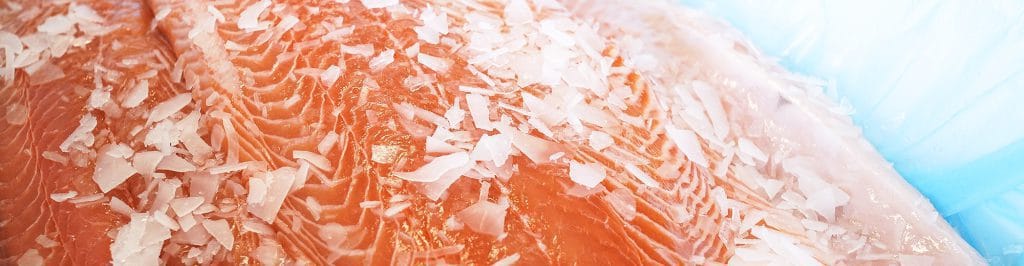
Scottish salmon has the characteristics of farmed Atlantic salmon: orange-pink flesh, a relatively high fat content, visible fat lines between the muscle segments, and fillets with a regular shape that portion well. Harvest weights are typically in the range of a few kilos, depending on growing period and target market.
Important for buyers: fat content, firmness and flavour are determined mainly by feed, growth rate, age at harvest, season and the part of the fish — not by the country name on the label. Differences between two Scottish batches can therefore be larger than the difference between a Scottish and a Norwegian batch. If you need a consistent specification, steer on size grade, trim, fat percentage and supplier, not on origin alone.
Scottish salmon versus Norwegian salmon
Scottish and Norwegian salmon are the same species, farmed in different countries under different regulatory frameworks. A general ranking in taste or quality cannot be substantiated. There are, however, differences that can be established objectively:
| Scottish salmon | Norwegian salmon | |
|---|---|---|
| Species | Atlantic salmon (Salmo salar) | Atlantic salmon (Salmo salar) |
| Production area | West coast, Hebrides, Orkney, Shetland | Norwegian coast, from the south-west to Finnmark |
| Volume | Smaller production volume | Largest producer worldwide |
| Supervision | Scottish and British regulation and regulators | Norwegian regulation and regulators |
| Origin protection | Scottish Farmed Salmon holds a Protected Geographical Indication | No comparable PGI; origin through labelling and documentation |
| EU trade status | Third country (UK): import with accompanying documents | Third country (EEA): import with accompanying documents |
What this table does not state is any verdict on taste, firmness or sustainability. Those properties vary per farm and per batch, in both countries. More background on the Norwegian side is available on the page about Norwegian salmon.
What role do farming and origin actually play?
Origin determines the legal framework, the supervision and the logistics. The concrete product properties come from the chain behind it. Four factors are decisive in practice: the farm and how it is run, the feed and therefore the fatty acid profile, the production system and growing period, and finally post-harvest handling — chilling, time to filleting, filleting technique and packaging.
For a buyer this means that “Scottish salmon” is not a specification in itself. It only becomes one in combination with supplier, size grade, trim level, fresh or frozen, and the accompanying documentation. How those steps work out in processing is described under salmon processing.
Certification and traceability
Several certifications occur with Scottish salmon. None of them applies automatically to all Scottish salmon: certification is always tied to a specific farm, processor or batch and must be evidenced per lot.
- ASC — private standard for responsible aquaculture, achieved per farm.
- RSPCA Assured — British standard focused on animal welfare in farming.
- Label Rouge — French quality scheme for which Scottish salmon can also qualify.
- PGI “Scottish Farmed Salmon” — Protected Geographical Indication, covering origin and production area.
- Organic (EU 2018/848) — only when the entire chain is organic certified; see organic salmon.
When buying, check the supplier’s certificate and the batch documentation, not only the stated origin. MSC does not apply here: that label covers wild capture fisheries, not farmed salmon.
Scottish salmon at Neerlandia Urk
Neerlandia Urk is a fish processor and salmon supplier in Urk, with its own salmon processing for retail, foodservice, wholesale and industry. Salmon is processed into salmon filletloinsportions and cubes, fresh or frozen, to customer specification.
At company level Neerlandia holds ASC, MSC, BIO, IFS Food, FDA and GLOBAL G.A.P., among others, and works according to the HACCP method. That certification applies to the company and the process. Whether a specific batch of Scottish salmon also carries ASC or organic status depends on the origin of that batch and follows from its documentation. More on this is available on the page about sustainability and certification.
Want to know which origins, product formats and specifications are possible in your situation, and which documentation goes with them? Ask your question directly.
Frequently asked questions about Scottish salmon
No. Scottish salmon is Atlantic salmon, Salmo salar, farmed in Scotland. The term refers to origin, not to a separate species. The same species is farmed in Norway, Ireland, the Faroe Islands and Chile, among others.
In the coastal waters of northern and western Scotland: the sea lochs along the west coast, the Hebrides, Orkney and Shetland. The fish starts in freshwater facilities and then grows on in sea cages.
It is the same species, farmed in different countries and under different supervision. Norway produces by far the largest volume; Scottish Farmed Salmon holds a Protected Geographical Indication. Differences in taste, fat content and firmness relate mainly to farm, feed, harvest age and processing, rather than to the country of origin as such.
Practically all Scottish salmon on the market comes from farming. Wild Atlantic salmon does occur in Scottish rivers, but that fishery is heavily regulated and plays almost no commercial role.
Among others ASC, RSPCA Assured, Label Rouge, the Protected Geographical Indication Scottish Farmed Salmon and — with a fully certified chain — organic under EU 2018/848. None of these certifications applies automatically to all Scottish salmon; they belong to a specific farm, processor or batch.
Questions about Scottish salmon or about a specific specification? Chat with us on WhatsApp.