

What is farmed salmon and how is salmon farmed?
Farmed salmon is salmon raised under controlled conditions in aquaculture. Atlantic farmed salmon starts its life in fresh water and, after smoltification, is usually grown on in seawater pens or in closed recirculating systems. Feed, water quality, fish health and origin all help determine the quality and environmental impact of the final salmon.
Farmed salmon in brief
- Species: almost always Atlantic salmon (Salmo salar).
- Production: freshwater phase, smoltification, grow-out in seawater or in a closed recirculating aquaculture system (RAS).
- Origin: Norway, Scotland, Ireland, the Faroe Islands and Chile, among others.
- Certification: ASC or a recognised organic label; MSC applies to wild-caught fish.
- Applications: whole fillet, loins, portions and cubes, fresh or frozen, for retail, foodservice and wholesale.
How is farmed salmon produced?
Salmon farming follows the natural life cycle of the fish, but in a managed environment. Production runs through five recognisable stages. Exactly how those stages are organised differs per country, per company and per farming system: legislation, water temperature, permits and company choices all shape the approach.
1. Eggs and the freshwater phase
Farming starts in a hatchery. Roe from selected broodstock is fertilised and incubated in fresh water. After hatching, the larvae first live off their yolk sac and then start feeding independently. Water temperature, oxygen levels and hygiene are closely monitored in this phase, because young fish are sensitive to them.
2. From young salmon to smolt
The young fish grows from fry to parr and then goes through smoltification: a physiological change that prepares the fish for salt water. In the hatchery this process is steered with light, temperature and feeding. Only once the fish has become a smolt can it move to sea or to a saltwater system.
3. Grow-out in seawater or a closed system
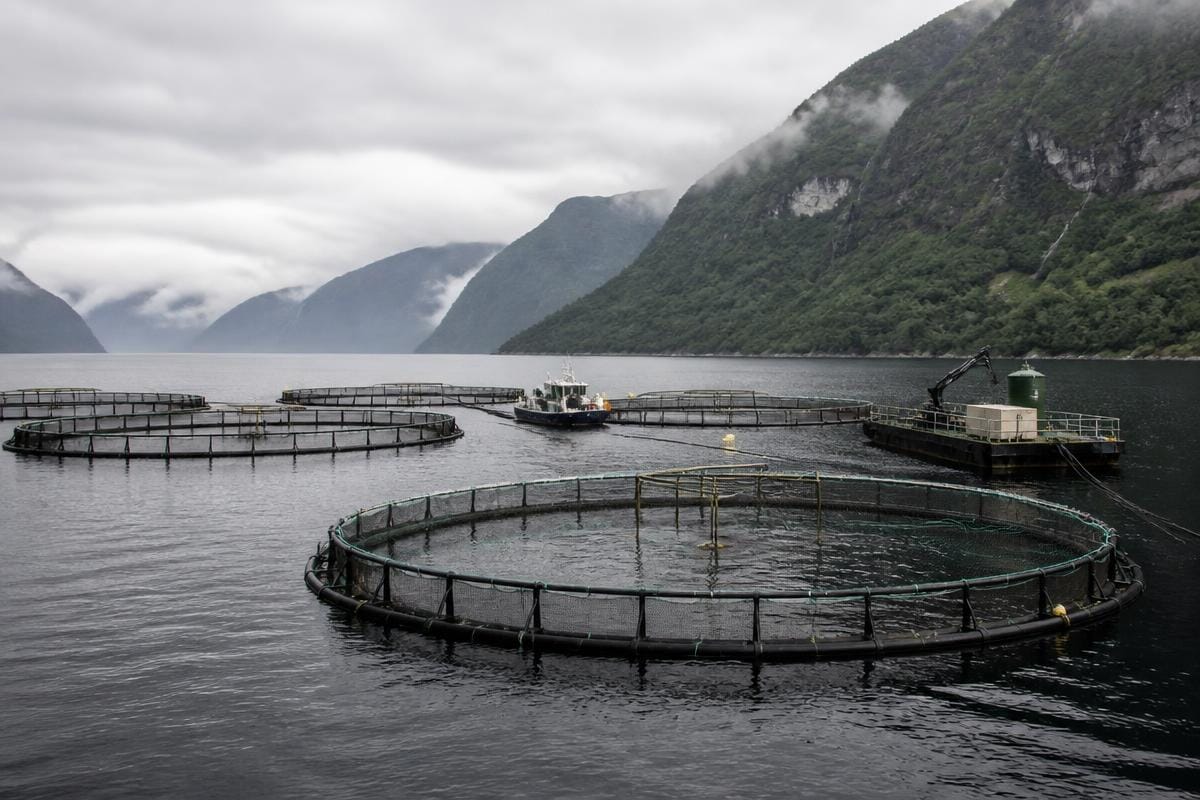
Most Atlantic salmon grows out in net pens in sheltered coastal waters and fjords, where currents flush the site. Salmon is also farmed in land-based recirculating aquaculture systems (RAS), where water is filtered and reused. Net pens use less energy but are in direct contact with the surrounding environment; RAS gives more control over water, disease pressure and escapes, but requires more energy and investment.
4. Feed and fish health
Farmed salmon receives formulated feed with a mix of marine ingredients (fishmeal and fish oil) and plant-based ingredients. That feed composition influences growth, fatty acid profile and the environmental impact of the chain. Fish health is mainly about prevention: stocking density, water quality, vaccination and monitoring for parasites such as sea lice. In the EU, veterinary medicines may only be used on a veterinarian’s indication, with statutory withdrawal periods before harvest. Growth hormones are not permitted in EU aquaculture.
5. Harvest, transport and processing
Once the target size is reached, the salmon is harvested, stunned, chilled and processed as quickly as possible. Chilled or frozen transport to processors and buyers follows. During salmon processing the fish is filleted, pin-boned, portioned and packed to specification. An unbroken cold chain and complete traceability determine much of the final quality at this stage.
Where is farmed salmon produced?
Atlantic salmon needs cold, oxygen-rich water. Farming is therefore concentrated in cold coastal regions: Norway, Scotland, Ireland and the Faroe Islands in Europe, and Chile in the southern hemisphere. In addition, salmon comes from land-based recirculating systems, which depend less on location. Origin matters to buyers because legislation, controls, seasonal influences and transport distance differ per region.
What is the difference between farmed and wild salmon?
Farmed and wild salmon are not better or worse versions of each other; they differ in habitat, diet, availability and application. For professional buyers, the key point is that farmed salmon is available year-round in consistent sizes, while wild salmon varies more by season and fishing ground.
| Characteristic | Farmed salmon | Wild salmon |
|---|---|---|
| Habitat | Seawater pens or land-based recirculating systems | Rivers and open sea |
| Diet | Formulated feed with plant-based and marine ingredients | Natural diet including crustaceans and smaller fish |
| Fat content | Generally higher and more consistent | Generally lower and more variable by species and season |
| Availability | Year-round, in consistent sizes | Seasonal, with varying sizes |
| Taste and texture | Milder in taste, softer and fattier structure | More pronounced in taste, often firmer structure |
| Origin | Norway, Scotland, Ireland, the Faroe Islands and Chile, among others | Mainly the North Pacific and some Atlantic fisheries |
| Certification | ASC or a recognised organic label | MSC for sustainable wild capture |
| Sustainability aspects | Feed ingredients, water quality, disease and sea lice, escapes, energy use in closed systems | Stock management, bycatch and fishing pressure |
Is farmed salmon healthy?
Salmon is an oily fish and provides protein, the omega-3 fatty acids EPA and DHA, vitamin D, vitamin B12 and selenium. European dietary guidelines generally recommend eating fish, including oily fish, on a weekly basis. Salmon fits well into a varied diet.
The exact nutritional value differs by origin, season, part of the fish and preparation method; feed composition plays a role too. Statements about individual health effects depend on the overall diet and lifestyle. For dietary advice, consult independent sources such as your national nutrition authority.
How sustainable is farmed salmon?
Salmon farming has both advantages and real challenges. The sustainability of a batch of salmon depends on the production system, farm management and the origin of the feed, not on the word “farmed” in itself.
What can help: controlled production allows planning, traceability and monitoring, and can reduce pressure on wild fish stocks when the share of marine ingredients in the feed stays limited.
Where the challenges are:
- Feed ingredients: fishmeal and fish oil come from fisheries; plant-based alternatives bring their own land use.
- Water quality and waste: feed residues and faeces can load the water around open net pens.
- Disease and parasites: sea lice and fish diseases require monitoring and treatment, with possible effects on wild fish.
- Escapes: escaped farmed fish can genetically influence wild populations.
- Open net pens versus RAS: closed recirculating systems limit escapes and emissions to surrounding water, but use more energy.
- Certification: a label assesses against defined criteria and provides guidance, but is not a guarantee of zero impact.
Read more about our own approach on the page about sustainability at Neerlandia.
ASC, organic and MSC: what do the labels mean?
For responsibly farmed salmon you can look for the ASC label or a recognised organic label. MSC is intended for sustainable wild-caught fish and not for farmed salmon.
- ASC (Aquaculture Stewardship Council): certification for responsible aquaculture, with requirements covering water quality, feed, fish health and working conditions, among others.
- Organic: production under EU organic regulation, with its own requirements for stocking density, feed and treatments, verified by an accredited control body. Read more about organic salmon.
- MSC (Marine Stewardship Council): certification for sustainable wild capture. An MSC logo therefore belongs to wild fish, not to farmed salmon.
A certificate always applies to a specific chain and batch. When purchasing, always ask for the certification that belongs to that particular delivery.
Farmed salmon at Neerlandia
Neerlandia Urk is a fish processor from Urk that processes and supplies salmon to retail, foodservice and wholesale. We work according to HACCP and to specification: whole fillet, loins, portions and cubes, fresh or frozen.
At company level, Neerlandia holds ASC, MSC, BIO, FDA, IFS Food and GLOBAL G.A.P., among others. An important distinction: certification at company or process level does not automatically mean every product is supplied as certified. Whether a specific batch is ASC or organic is stated in the documentation and labelling of that batch.
Looking for farmed Atlantic salmon for hospitality, retail or wholesale? View our salmon range.
Ask our sales team about current options via WhatsApp or through the contact page.
Frequently asked questions
Farmed salmon is salmon raised in aquaculture under controlled conditions. In Europe this is almost always Atlantic salmon (Salmo salar). The fish starts in fresh water and, after smoltification, grows on in seawater pens or in a closed recirculating system.
Production runs in phases: fertilisation and incubation of the eggs, a freshwater phase in which the fish develops into parr and then smolt, a grow-out phase in seawater or a closed system, and finally harvest, chilling, transport and processing. The exact approach differs per country and per farm.
Wild salmon lives on natural food and is available seasonally; farmed salmon grows on formulated feed and is available year-round in consistent sizes. Farmed salmon generally has a higher fat content and a milder taste. Which one fits best depends on application, specification and origin requirements.
Salmon contains protein, omega-3 fatty acids (EPA and DHA), vitamin D, vitamin B12 and selenium. European dietary guidelines generally recommend eating fish weekly, including oily fish. Salmon therefore fits into a varied diet; individual health effects depend on the overall diet.
In the EU, veterinary medicines may only be used on indication and under the responsibility of a veterinarian, with statutory withdrawal periods before fish may be harvested. Growth hormones are not permitted in EU aquaculture. Actual use differs per country and per farm, so always ask about the origin and documentation of a specific batch.
That depends on the production system and its management. Points of attention are the origin of feed ingredients, water quality and waste, disease and sea lice, escapes and the use of open net pens. Closed recirculating systems limit some of those risks but use more energy. Certification provides guidance but is not a guarantee of zero impact.
For responsibly farmed salmon you can look for the ASC label or a recognised organic label. MSC is intended for sustainable wild-caught fish and not for farmed salmon.
Atlantic farmed salmon mainly comes from cold coastal waters: Norway, Scotland, Ireland, the Faroe Islands and Chile are well-known production areas. In addition, salmon is farmed in land-based recirculating systems in various countries.