

Organic salmon
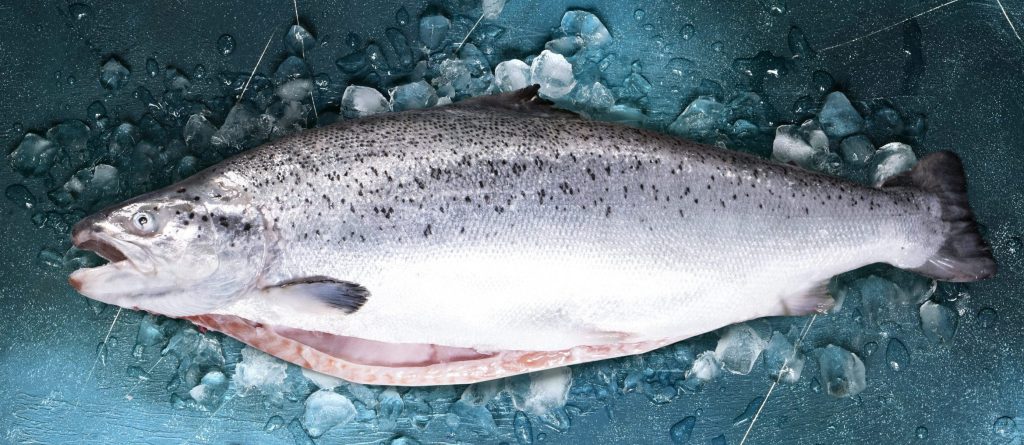
Organic salmon is Atlantic salmon (Salmo salar) farmed in line with the European rules for organic production. Those rules are set out in Regulation (EU) 2018/848 and the implementing rules for aquaculture. They cover feed, stocking density, the origin of juvenile fish, the use of veterinary medicines and the records that make a batch traceable.
Salmon may only be sold as organic when the entire chain — farm, processing and trade — is certified and inspected annually by an approved control body. Organic therefore says something about the production method and the checks on it, not automatically about taste, freshness or nutritional value.
What is organic salmon?
Organic salmon comes from organic aquaculture: fish farming according to a fixed set of production rules, with independent verification of compliance. In the European Union this is governed by Regulation (EU) 2018/848 on organic production and the labelling of organic products, with specific requirements for aquaculture animals in its annexes and implementing acts.
The core principle of organic aquaculture is that production stays as close as possible to the natural behaviour and physiology of the species, that feed has an organic or controlled origin, and that every link in the chain can demonstrate it works to those rules. A farmer, a processor and a trader each need their own certificate. If certification is missing anywhere in the chain, the end product may no longer be labelled organic — even when the fish itself was farmed organically.
Organic is therefore a legally protected term. The European organic logo and the code number of the control body on the packaging are the formal proof; wordings such as “natural” or “artisanal” carry no such status.
What must organic salmon comply with?
The European rules for organic aquaculture define the conditions under which salmon may be farmed. They are concrete and verifiable, and that is exactly what separates the organic label from a marketing claim. The main conditions for salmon are:
- Stocking density: for salmon in sea cages, EU rules set a maximum of 10 kg per cubic metre, giving the fish more space per unit of volume than is usual in conventional farming.
- Feed: plant-based raw materials must be organic; fishmeal and fish oil must come from certified sustainable fisheries or from trimmings of fish processed for human consumption.
- Juvenile fish: production starts in principle from organically reared juveniles; deviations are only possible within the exceptions the regulation itself names.
- Veterinary medicines: preventive use of chemically synthesised products is not allowed. Treatment is only permitted on indication, the number of allopathic treatments per year is capped and the statutory withdrawal period is doubled.
- Hormones: the use of hormones and hormone derivatives is prohibited.
- Traceability and control: every certified link keeps records that make batches traceable and is inspected at least once a year.
These requirements apply to the production method. They say nothing about the composition of the end product: no organic standard prescribes a particular fat content, omega-3 level or flavour profile.
What is the difference between organic and conventional farmed salmon?
The difference lies in the rules production must meet and in how compliance is supervised — not in a fundamental difference between a “clean” and a “contaminated” fish. Conventional salmon farming in the EU and Norway is also subject to legislation on animal health, food safety and the environment, with checks on residues and on the use of veterinary medicines.
Two misconceptions persist. The first is that conventional farmed salmon is routinely given growth hormones: using hormones as growth promoters is banned in European animal production, so this is not a distinguishing point between organic and conventional. The second is that conventional farmed salmon routinely receives antibiotics. Antibiotics may only be prescribed by a veterinarian for a diagnosed condition, with a mandatory withdrawal period. In Norwegian salmon farming, antibiotic use dropped sharply after vaccination was introduced. What the organic rules add is a stricter limit on the number of treatments and a doubled withdrawal period.
Where organic salmon does systematically differ from conventional farmed salmon is in the fixed stocking density, the origin rules for feed, the restriction on preventive treatments, and the mandatory certification and annual inspection of every link in the chain. For buyers, that last point is often the practical difference: organic salmon comes with documentation proving the status of the batch.
Claims that organic salmon is healthier or contains more omega-3 cannot be substantiated in general terms. Fat content and fatty acid composition depend mainly on feed, age at harvest and the part of the fish, and these vary within both organic and conventional farming.
What is the difference between BIO, ASC and MSC?
BIO, ASC and MSC are three different systems. They are not interchangeable and one label does not imply another. BIO is European legislation for organic production, ASC is a private standard for responsible farming, and MSC is a private standard for wild-capture fisheries.
| BIO (organic) | ASC | MSC | |
|---|---|---|---|
| Applies to | Farming (aquaculture) and processing | Farming (aquaculture) | Wild-capture fisheries |
| Basis | EU Regulation 2018/848 | Private standard of the Aquaculture Stewardship Council | Private standard of the Marine Stewardship Council |
| What it covers | Organic production rules: feed, density, veterinary medicines, traceability | Environmental impact and social conditions of the farm | State of the fish stock and impact of the fishery |
| What it does not say | Nothing about wild fisheries; no product standard for taste or nutrition | ASC does not mean organic | MSC does not apply to farmed fish and is not an organic label |
A batch of salmon can be both organic and ASC certified, but that is not automatic: these are two separate certification processes. For salmon, MSC only comes into play with wild-caught fish, and wild salmon can by definition not be organic, because organic certification assumes a controlled farming process.
Where does organic salmon come from?
Organic salmon is almost always Atlantic salmon, Salmo salar, farmed in cold, flowing seawater. The best-known production areas are in Northern Europe: Norway, Ireland and Scotland. Norway is the largest producer of farmed Atlantic salmon overall; within that, the organic segment is a small share of total production.
For the European market, salmon from outside the EU may only be sold as organic when production meets the EU rules or a system recognised as equivalent, with the corresponding certificates. To check the origin and status of a batch, look at the supplier’s certificate and the code number of the control body, not at the country of origin alone. More background on farming in general is available on the pages about farmed salmon and Norwegian salmon.
Which organic salmon products are available?
Organic salmon is traded in the same product forms as conventional farmed salmon. Which form fits depends on the application: a kitchen portioning by weight, a meal manufacturer and a retailer with consumer packs each need something different.
- Salmon fillet, with or without skin and bones, in various trim levels
- Salmon loins: the thick, even part of the fillet
- Salmon portions cut to weight
- Salmon cubes and trim for further processing
These forms exist fresh and frozen. With frozen salmon, the freezing method partly determines quality after thawing. Important for organic batches: every operation — filleting, portioning, packing, freezing — must take place at a certified processor, otherwise the organic status on the label is lost. See also how salmon processing works in practice.
Organic salmon at Neerlandia
Neerlandia Urk is a fish processor and salmon supplier based in Urk, with in-house salmon processing for retail, foodservice, wholesale and industry. At company level Neerlandia holds BIO certification, alongside ASC, MSC, IFS Food, FDA and GLOBAL G.A.P., among others; work is carried out according to HACCP. More about this is on the page about sustainability and certification.
That distinction matters in practice. BIO certification at company and process level means Neerlandia may process organic batches and market them as organic, provided separation in the process and in the records is in order. It does not mean every Neerlandia product is organic: organic status always belongs to a specific batch, with the accompanying documentation from the supplier and from processing.
For buyers, these are the four levels to keep apart: the company that is certified, the process in which organic and conventional flows stay separated, the product labelled as organic, and the raw material supplier who must be certified as well. Would you like to know which organic salmon products and processing formats are possible in your case, and what documentation comes with them? Put the question to us directly.
Frequently asked questions about organic salmon
No general statement can be made about that. The organic rules concern the production method, not the composition of the end product. Fat content and fatty acid composition depend mainly on feed, age at harvest and the part of the fish, and these differ within both organic and conventional farming.
No. BIO is European legislation for organic production; ASC is a private standard for responsible farming. A batch can hold both certifications, but one does not follow from the other.
No. Organic certification assumes a controlled farming process with requirements for feed, housing and treatment. Wild salmon falls outside that and can at most fall under a fisheries standard such as MSC.
By the European organic logo on the packaging, together with the code number of the control body and the origin statement. In trade, the supplier’s certificate belongs with it, allowing the status of the batch to be verified.
Yes, provided every processing link is itself organically certified and the organic flow stays separated from the conventional flow in the process and in the records. Without that certification and separation, the end product may not be labelled organic.
Questions about organic salmon or about a specific specification? Chat with us on WhatsApp.