


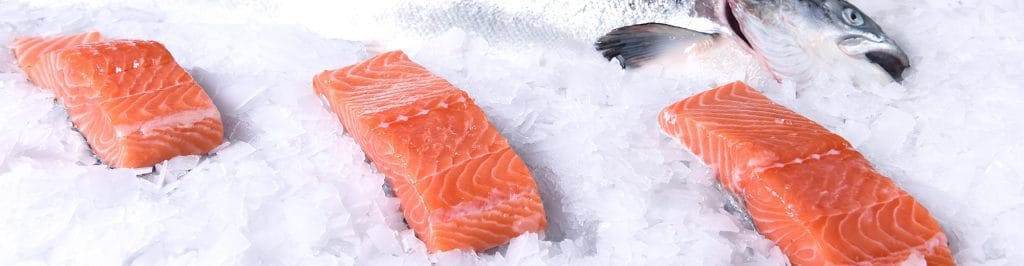
What makes Norwegian salmon so popular?
Norwegian salmon is popular because its quality is predictable: the fish has a mild, slightly fatty taste, a firm texture and an even orange-red colour, and because it is farmed in Norway it is available all year round. That combination makes Norwegian salmon usable across very different applications — from sushi and sashimi to smoking, cooking and further processing.
For chefs, retailers and processors it also matters that Norwegian salmon holds few surprises. The fish can largely be filleted bone-free, portions well and delivers a consistent end result. Where many species are seasonal and fluctuate strongly in supply, Norwegian salmon is one of the most constant products on the fish counter. Below you can read what Norwegian salmon actually is, where those properties come from and what the fish is used for.
What is Norwegian salmon?
Norwegian salmon is Atlantic salmon (Salmo salar) farmed in the cold coastal waters of Norway. It is therefore not a separate species but an indication of origin: the same species that occurs naturally in the North Atlantic, only coming from aquaculture instead of from fisheries. Norway is one of the world’s largest producers of Atlantic salmon (FAO).
In practice this means that virtually all Norwegian salmon you encounter in hospitality, retail or wholesale is farmed salmon. Wild Atlantic salmon barely features in commercial trade any more. More background on that farming process is available in the article what is farmed salmon and how is it produced, and the characteristics of the species are described in the key characteristics of Salmo salar.
The four main reasons for its popularity
The popularity of Norwegian salmon comes down to four properties that reinforce each other:
- Year-round availability — farming is not tied to a catch season.
- Consistent quality — colour, fat content and texture stay close together, batch after batch.
- Mild taste — not pronouncedly fishy, which makes it widely accepted.
- Broad usability — raw, smoked, cooked or processed, in almost any kitchen concept.
None of these points is unique in itself. What sets Norwegian salmon apart is that they coincide in one product that is also available in large volumes and in fixed specifications. That allows a restaurant to build a permanent dish on it and a retailer to fill a shelf year-round, without the purchase price or the quality shifting from season to season.
How is Norwegian salmon farmed?
Norwegian salmon grows up in two phases. The fish begins its life in fresh water, as it does in nature, and after smoltification — the physiological switch to salt water — moves to sea pens along the Norwegian coast. There the salmon grows on to harvest weight.
The Norwegian coast lends itself well to this: deep fjords, plenty of current and cold, oxygen-rich water all year round. Those conditions produce even growth and contribute to the firm texture of the flesh. Because the fish grows in the sea under comparable conditions, variation between batches stays relatively small. In Norway the sector is regulated through licences and monitoring of animal health and the environment; background information on this is published by the Norwegian Seafood Council, among others.
Why Norwegian salmon is available all year round
Norwegian salmon can be supplied year-round because the fish is farmed and harvested when it reaches weight, not when a catch season permits it. With wild capture, seasons, quotas, weather and fishing grounds determine supply; with farming the harvest can be planned.
For professional buyers that difference is often more decisive than taste. A menu with salmon does not have to change when the season turns, a shelf stays filled and a production line can keep running on fixed specifications. Prices therefore move more calmly than for many seasonal species, although salmon, like any agricultural product, remains sensitive to market fluctuations.
How does Norwegian salmon taste and feel?
Norwegian salmon has a mild, slightly sweet taste and a relatively high fat content. The fat is visible as white marbling in the flesh and keeps the fish juicy when frying, grilling or smoking; raw, it gives a soft mouthfeel as well. That mildness explains a large part of the popularity: the taste is accessible to people who eat little fish and combines well with widely differing preparations.
The characteristic orange-red colour comes from astaxanthin, a natural pigment the salmon takes in through its feed. In the wild, salmon obtains that pigment from crustaceans; in farming it is added to the feed. The pigment is therefore not a colourant applied afterwards, but part of the nutrition during growth.
What is Norwegian salmon used for?
Norwegian salmon is used for raw preparations, hot dishes and further processing. In sushi and poke kitchens the fish is common because of its firm texture and even colour; in the hot kitchen the work is mainly with fillet, loins and portions by weight. Salmon is also a base product for smoked products, salads, ready meals and foodservice concepts.
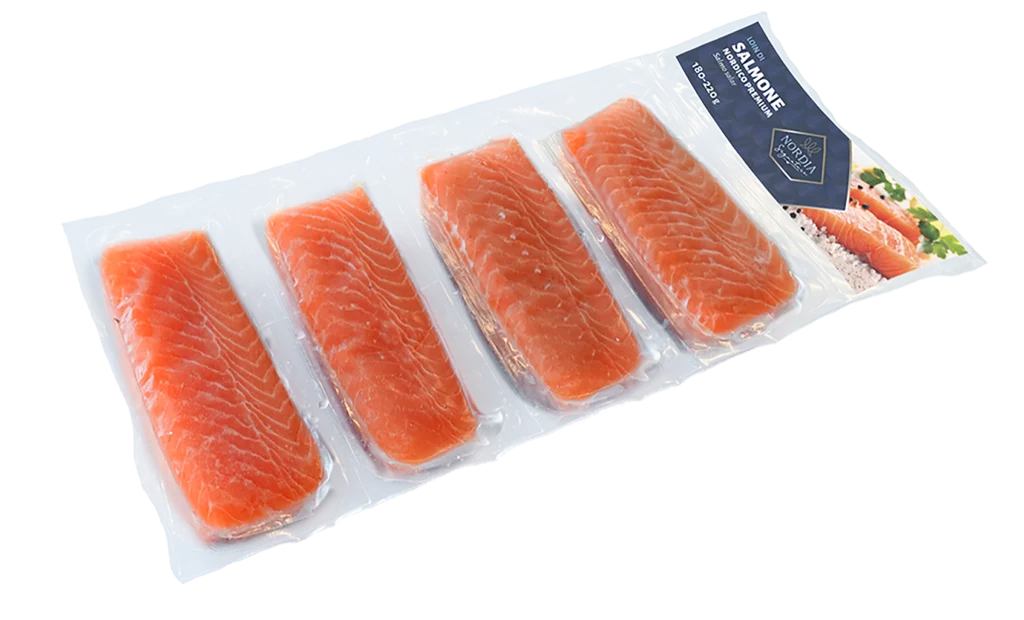
Which product form fits depends on the application. A restaurant that wants a fixed portion cost prefers salmon portions by weight; a kitchen that wants to cut its own is more likely to choose salmon fillet or salmon loins. For salads, poke and industrial applications, salmon cubes are often used.
Norwegian salmon and Scottish salmon compared
Norwegian and Scottish salmon are the same species: Atlantic salmon. The difference lies in the origin and in how that origin is used in the market, not in a fundamentally different product.
| Norwegian salmon | Scottish salmon | |
|---|---|---|
| Species | Atlantic salmon (Salmo salar) | Atlantic salmon (Salmo salar) |
| Origin | Farmed along the Norwegian coast and fjords | Farmed along the Scottish west coast and islands |
| Availability | Ample and all year round | Smaller production volume than Norway |
| Positioning | Broadly usable volume product | Often used as an origin mention on menu or label |
Taste differences between individual batches do occur, but relate more strongly to fat content, feed and growing time than to the country of origin alone. If you are specifically interested in Scottish origin, read on in what makes Scottish salmon unique.
Sustainability and certification of farmed salmon
Salmon farming rightly raises questions about environmental impact, feed and animal health. For farmed salmon there are therefore certification schemes awarded at product level, such as ASC for responsible aquaculture and organic certification for organically farmed salmon. MSC applies to wild capture only and therefore not to farmed salmon.
An important distinction: a certificate can apply to a specific batch of fish, and separately a processing company can be certified for food safety and supply chain management. Those two are not the same. A company certification does not automatically mean that every batch of salmon is product-certified — that is always stated on the product specification of the shipment concerned. How Neerlandia Urk handles this is set out on the sustainability page.
What Norwegian salmon means for professional buyers
For retail, hospitality, wholesale and the processing industry, the popularity of Norwegian salmon translates above all into predictability. Because supply is stable, a buyer can work with fixed specifications: a set gram weight per portion, a fixed trim level or a fixed packaging format. That makes cost prices predictable and limits waste in the kitchen or on the line.
In practice, Norwegian salmon is therefore rarely purchased as a whole fish. Most professional buyers purchase fillet, loins, portions or cubes, fresh chilled or frozen, matched to turnover rate and storage capacity.
Neerlandia Urk and salmon processing
Neerlandia Urk is a fish processing company in Urk that processes salmon, among other species, for professional buyers. The company works according to HACCP and holds the certifications ASC, MSC, BIO, FDA, IFS Food and GLOBAL G.A.P. Which of these apply to a specific batch or shipment is recorded per order.
Would you like to know which product form or specification suits your application? Have a look at the page on salmon processing or at what Neerlandia offers as a salmon supplier, or ask your question directly.
Frequently asked questions about Norwegian salmon
Is Norwegian salmon wild or farmed?
Norwegian salmon on the commercial market is almost always farmed salmon, raised in sea pens along the Norwegian coast. Wild Atlantic salmon plays hardly any role in commercial trade.
Which salmon species comes from Norway?
Atlantic salmon, scientific name Salmo salar. “Norwegian salmon” indicates origin, not a separate species.
Is Norwegian salmon available all year round?
Yes. Because the fish is farmed and harvested when it reaches weight, Norwegian salmon is not tied to a fishing season and is available throughout the year.
What is the difference between Norwegian and Scottish salmon?
Both are Atlantic salmon (Salmo salar). The difference is origin: Norwegian salmon is farmed along the Norwegian coast, Scottish salmon along the west coast and islands of Scotland. Norway produces the larger volume; Scottish origin is more often used as a mention on menus or labels.
Why is salmon orange-red?
Because of astaxanthin, a natural pigment the salmon takes in through its feed. In the wild that pigment comes from crustaceans; in farming it is added to the feed.
What is Norwegian salmon used for?
For raw preparations such as sushi, sashimi and poke, for hot dishes, for smoked products and for further processing into salads, ready meals and foodservice concepts.
Is farmed Norwegian salmon sustainable?
That differs per batch and per farm. Certification schemes such as ASC and organic certification exist for farmed salmon and are awarded at product level. MSC applies to wild capture only. Whether a specific batch is certified is stated on the product specification.
Questions about Norwegian salmon or about a specific product form? You can ask your question via WhatsApp or contact Neerlandia Urk.