


What is farmed fish?
Farmed fish in brief
Farmed fish is fish produced through aquaculture: the controlled rearing of fish and other aquatic organisms in fresh or salt water. Conditions, feed and farming systems differ per species and producer. Whether farmed fish is a sustainable choice therefore depends on factors such as the species, the farming system, the feed and any certification.
Farmed and wild fish differ mainly in origin and production method: farmed fish grows within a managed system, while wild fish lives in natural waters and is caught by fisheries. Both categories exist side by side on the professional market, often even within the same species.
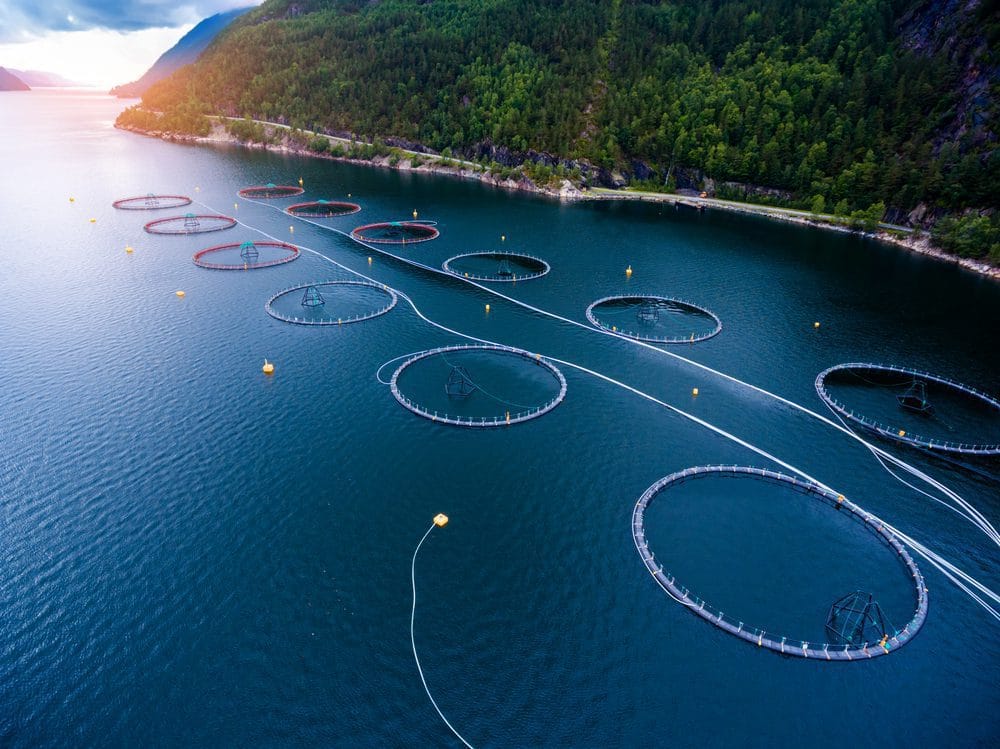
Farmed fish, aquaculture and fish farming: the same principle
The terms farmed fish, fish farming and aquaculture all refer to the same principle. Aquaculture is the broader term and also covers shellfish, crustaceans and seaweed. Farmed fish should not be confused with soaked or marinated fish, which simply describes fish that has been kept in liquid and has nothing to do with fish farming.
How does aquaculture work?
Aquaculture is the rearing of fish in a managed system, from juvenile stage to market size. The farmer manages water quality, stocking density, feed and animal health, among other things. The systems used vary considerably.
Cages or nets in the sea or in lakes are widely used for salmon and sea bass. Such systems are in open contact with the surrounding water, which makes water quality and disease pressure key points of attention. Ponds and tanks are common for tilapia, catfish and carp. In recirculating aquaculture systems (RAS) the fish are farmed on land in a closed system where the water is filtered and reused.
Feed determines a large share of the environmental impact. For carnivorous species such as salmon, feed has traditionally contained fishmeal and fish oil; producers also use plant-based feed ingredients and, increasingly, alternatives such as insect meal. The composition differs per producer and per species.
Which fish species are farmed?
A wide range of species is farmed worldwide. On the European market you mainly encounter these:
- Salmon (Salmo salar) – the best-known farmed fish in North-West Europe, with Norway and Scotland as important origins. Read more about how farmed salmon is produced.
- Tilapia – a widely farmed species with a mild flavour that grows well in various systems.
- Pangasius and catfish – freshwater species commonly kept in pond and tank systems.
- Sea bass and sea bream – farmed extensively in the Mediterranean region.
- Trout, eel and shrimp – each with its own market and processing chain.
Which species is farmed where depends on climate, water type, market demand and the cost of feed and energy.
Is farmed fish sustainable?
There is no general answer. Aquaculture can reduce pressure on wild fish stocks, but environmental performance varies strongly by species, farming system, feed, location and producer. Poorly managed farming can cause local water pollution, disease pressure and escapes; well-managed farming limits those effects. Farmed fish is therefore not automatically more sustainable, healthier or more environmentally friendly than wild fish, and the reverse is equally untrue.
Certification: telling ASC, organic and MSC apart
ASC (Aquaculture Stewardship Council) is the label for responsibly farmed fish, shellfish and crustaceans. Organic certification is a separate system with its own requirements for feed, stocking density and veterinary medicines; organic and ASC are different certification schemes and not interchangeable. MSC (Marine Stewardship Council) applies to wild-capture fisheries and is not a label for farmed fish.
For an assessment per species and origin, independent seafood guides and the certification schemes themselves are the most reliable sources. You can read more about organic certification on our page about organic salmon.
Farmed fish versus wild fish
The table below sets out the main differences. Neither category is better by definition: the outcome depends on the species, the farming system or fishing method and the origin.
| Characteristic | Farmed fish | Wild fish |
|---|---|---|
| Origin | Aquaculture system in fresh or salt water | Natural waters: seas, lakes and rivers |
| Production method | Rearing in cages, tanks, ponds or recirculating systems | Capture with fishing techniques such as nets, lines or trawls |
| Feed | Formulated feed; a mix of fishmeal, fish oil and plant-based or alternative ingredients | Natural diet, depending on species and habitat |
| Availability | Generally year-round and plannable in volume and sizing | Depends on season, quota and catch success |
| Environmental effects | Depend on system, location and feed; key points are water quality, disease pressure and feed ingredients | Depend on stock and fishing method; key points are overfishing, bycatch and seabed impact |
| Relevant certification | ASC, organic certification | MSC |
Nutrition and health
Fish provides protein, vitamins and minerals, and oily species such as salmon, mackerel and herring contain omega-3 fatty acids. The exact nutritional value differs per species, feed and production method; differences also occur within the same species. Both farmed and wild fish can be part of a varied diet.
What to check when buying farmed fish
For professional buyers it mainly comes down to recording origin, specification and chain of custody. These points help:
- Species and origin – ask for the species, country of origin and farming system; together they determine quality and environmental profile.
- Certification – check that the label matches the production method: ASC or organic for farming, MSC for wild capture.
- Freshness and cold chain – assess smell, colour, firmness and the temperature at which the product was stored and transported. See also our page about buying fish.
- Specification and sizing – record the form, weight class and packaging in which the product is delivered.
- Documentation – ask for traceability and the specifications per batch.
Neerlandia Urk processes and supplies fish to retail, foodservice and wholesale. See our product range or the contact details of Neerlandia.
Frequently asked questions
Farmed fish is fish kept and produced through aquaculture in controlled fresh or salt water systems, for example in ponds, tanks or sea cages.
Nutritional value differs per species, feed and production method. Both farmed and wild fish can be part of a varied diet. General health claims without a reliable source are out of place.
Farmed fish grows within an aquaculture system where feed and living conditions are managed. Wild fish lives in natural waters and is caught by fisheries.
That varies by species, farming system, feed, location and producer. Use certification and reliable seafood guides to assess specific products.
ASC is the label for responsibly farmed fish, shellfish and crustaceans. MSC applies to wild-capture fisheries and is therefore not the same.