Types of salmon
Because we sell different types of salmon at Neerlandia Urk, we want to explain in this blog what the differences are. From Atlantic salmon to Pacific salmon. Why is one salmon more flavorful than another? And what makes the salmon unique? You’ll get answers to these questions and more.
Atlantic salmon in ocean phase and spawning phase
There is one species of Atlantic salmon, which you can divide into several. These salmon often bear the name where they are caught or farmed. There are only minor differences between these species, mainly related to taste and shape. Between Scottish and Norwegian salmon, however, there are obvious differences such as quality, fat percentage and shape. For more information, see this blog
The main difference between Atlantic salmon and Pacific salmon comes from the spawning process. Atlantic salmon migrate back to their birthplace when they have accumulated enough fatty tissue. This occurs in late spring. How long the rearing phase is depends on the energy, which is needed for the spawning migration, which often goes deep into the river systems. These trips are tough and sometimes full of obstacles. The rivers are often freshwater. This is where the larvae are born and live for the first period. When the salmon are large enough they migrate to the ocean to repeat the cycle and get used to salt water. The adult salmon migrate back to the Atlantic in large numbers after the spawning season.

Pacific salmon:
There are seven different species of salmon in the Pacific Ocean. Five are found primarily in North American waters. These are the chinook, coho, chum, sockeye, and pink. The other two masu and amago occur off Asia.
Chinook salmon and king salmon in ocean phase and spawning phase
The chinook salmon (king salmon) is the largest species of salmon in the Pacific Ocean. This salmon can be identified by its distinctive beak. It is said to be the most flavorful salmon because it has a high fat percentage. The taste is described as creamy and rich. The high natural fat percentage also makes this a very healthy option for humans because of the OMEGA-3. The color of the fillet is red-orange with occasional gray tones. When they enter the spawning period, these salmon swim many miles upstream. After spawning, the salmon die. This occurs in late spring to early fall.
Coho salmon in ocean phase and spawning phase
The Coho salmon or silver salmon as this species is also called is a small salmon compared to the other species. The salmon is normally silver, but turns red when emigrating for the spawning season. After spawning, this salmon cannot be consumed unlike other salmon species. This salmon has a mild flavor with a normal fat percentage. The salmon fillet is deep red.
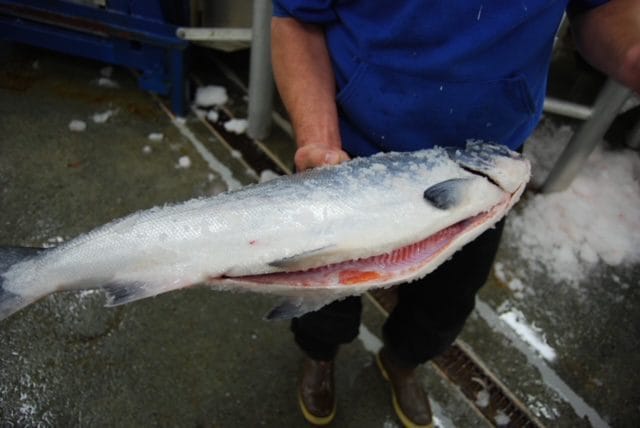
Sockeye Salmon in ocean phase and spawning phase
Sockeye salmon or called red salmon is normally gray to blue in color, but turns red during the spawning phase. However, you will never be able to buy a red colored salmon because the salmon are caught before the spawning season because of taste. Salmon are often caught wild because they are not suitable for breeding. The taste is described as full, robust and fishy. The fillet is red in color. After the chinook salmon, the sockeye salmon is the fattest and therefore more flavorful and slightly healthier.
Farmed vs wild-caught salmon?
Because the demand for salmon has increased considerably in recent years, it is more difficult to buy wild salmon. Also, these salmon are often less flavorful. When salmon are farmed, they are fed special pellets which give them a higher fat percentage. As explained earlier, this gives the salmon the most flavor. In this blog we explain in detail the differences and advantages with farmed or wild salmon.
Frequently asked questions
The main difference between these two types of salmon lies in their habitat, flavour, and fat content. Atlantic salmon is a single species (Salmo salar) found in the North Atlantic Ocean and is mostly farm-raised, resulting in a mild flavour and consistent fat content. Pacific salmon, on the other hand, includes several species such as Chinook, Coho, Sockeye, Pink, and Chum salmon. These are usually wild-caught and have more variation in colour, taste, and texture, with some species offering a richer and oilier flavour profile.
Chinook salmon, also known as King salmon, has the highest fat content among all types of salmon, which gives it a rich, buttery texture and a deep, satisfying flavour. This high concentration of healthy omega-3 fatty acids not only enhances the taste but also contributes to its nutritional value. Its large size and delicate texture make it one of the most premium and sought-after types of Pacific salmon.
Sockeye salmon, often called “red salmon,” stands out because of its bright red flesh and bold, full flavour. Unlike milder types of salmon, sockeye has a firm texture and is typically wild-caught in the cold waters of the Pacific. Its strong flavour and high fat content make it ideal for grilling or smoking. Because it’s harvested before the spawning phase, the meat retains its colour, nutrients, and rich taste.
During the spawning phase, salmon use up their fat reserves to migrate and reproduce, which causes changes in their body shape, colour, and taste. As a result, the flesh becomes leaner and less flavourful. For consumers, this means that high-quality salmon—especially premium types like Sockeye or Chinook—is typically caught before spawning to preserve its optimal taste, texture, and nutritional content.
Farmed salmon generally contains more fat because it is raised in controlled environments and fed a nutrient-rich diet, giving it a milder and often creamier taste. Wild-caught salmon, such as Pacific species, tends to have firmer meat and a more pronounced flavour due to natural feeding patterns and colder water conditions. Both types of salmon offer unique benefits—farmed salmon provides consistency and year-round availability, while wild salmon offers a more natural taste and texture.
There are five main types of Pacific salmon: Chinook (King), Coho (Silver), Sockeye (Red), Pink, and Chum salmon. In Asia, there are also Masu and Amago salmon. Each species has unique characteristics—Chinook is known for its high fat and rich flavour, Coho for its mild taste and firm texture, and Sockeye for its vibrant red colour. Pink and Chum salmon are leaner and more commonly used for smoking or canning.
Look for suppliers that focus on traceability, sustainable fishing practices, and quality control. Neerlandia Urk, for instance, partners with farms and fisheries that meet strict international standards, ensuring that every salmon fillet is handled with care, processed quickly after catch, and meets the highest food safety regulations. Certifications such as ASC (Aquaculture Stewardship Council) or MSC (Marine Stewardship Council) are also strong indicators of quality and sustainability.
Questions about our salmon products?
Under our special brand Nordia Signature the highest standards are set for our different types of salmon products. Neerlandia Urk only cooperates with salmon farms, which also stand for sustainability and quality. Neerlandia Urk wants to keep up with the latest developments in farming so that the fish is farmed and processed in an increasingly environmentally friendly way. Only if we continue to set high standards for ourselves will we fulfill our own core values.
Contact us
For more information, contact our sales team